

Explorations
Benini: Where Color Found a Home in the Texas Hill Country
At the end of a quiet Hill Country road, one artist’s lifetime opens room by room—in roses, ribbons, spheres, stars, and colors that seem to hold their own light.
In this story
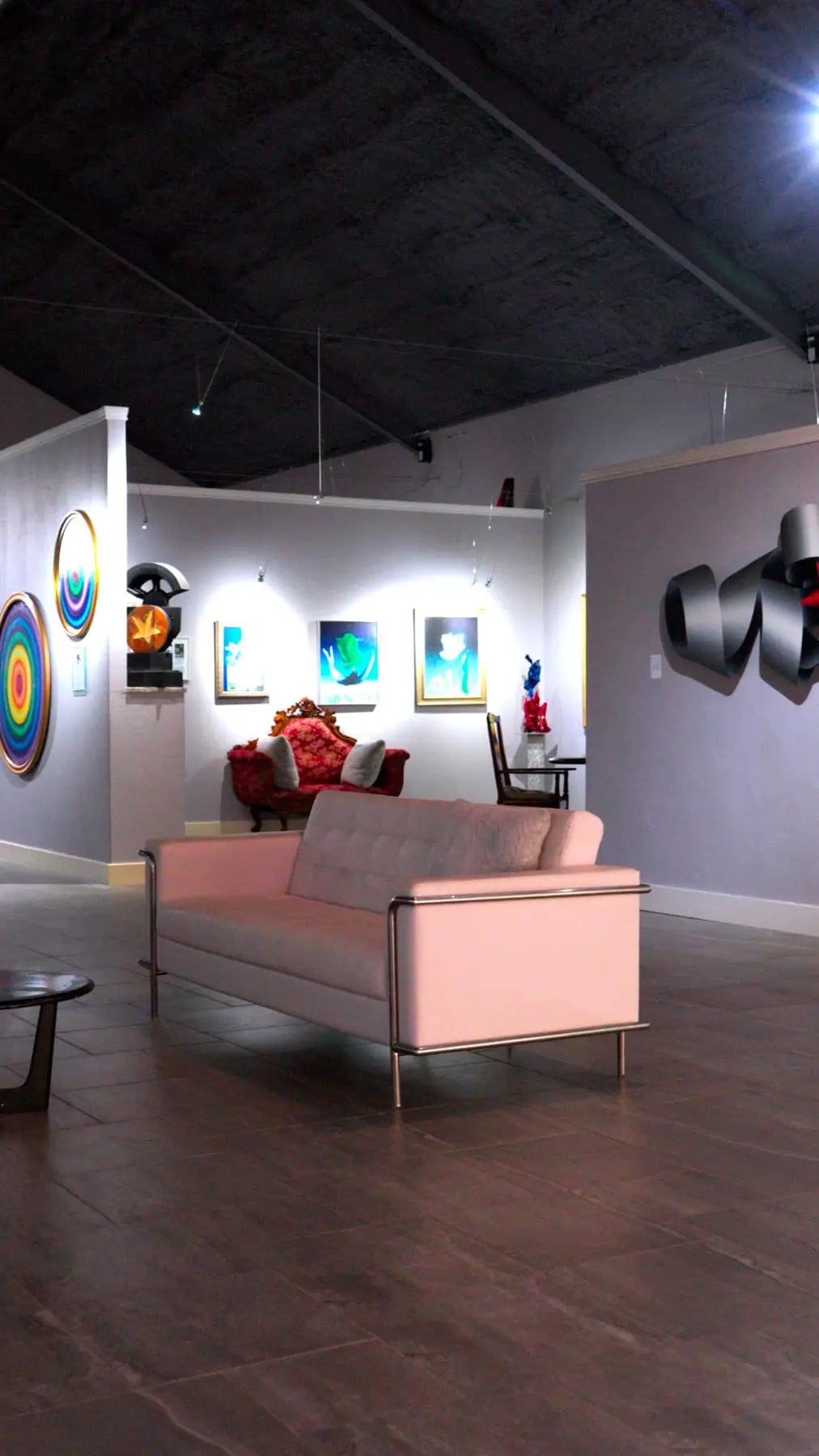
There are museums that gather the lives of many artists, and there are rarer places that ask us to remain with one vision long enough to watch it change. Museo Benini, south of Marble Falls, belongs to the second kind. Its 6,500 square feet do not preserve a single period or a recognizable signature. They hold the long argument an artist has carried on with himself: what to keep, what to abandon, what can be made visible, and what must remain just beyond reach.
The artist is known simply as Benini. Born in Imola, Italy, in 1941, he has spent more than six decades building a language of color. The road to this Texas museum passed through postwar Italy, the Alps, the Atlantic, Grand Bahama, Florida, Arkansas, and a ranch near Johnson City. It passed through roses large enough to become architecture, through surreal dreamscapes and strict geometric systems, and finally into fields of poured and blended acrylic that feel less painted than illuminated.
The boy who carried an easel on a bicycle
Benini’s earliest memories were formed under the shadow of the Second World War, yet his adult work would move insistently toward color. As a teenager he left home and traveled through the Emilia-Romagna region, painting landscapes and portraits in oil and watercolor. His bicycle became transportation, studio, and easel. There was no academy waiting to give him a method. He learned by looking, working, leaving, and beginning again.
Military service placed him in an Alpine ski patrol. Later, life at sea carried him to New York, where he encountered acrylic paint in 1965 and began using it exclusively. That new material offered speed, transparency, and the possibility of building color through layer after layer. It became the medium through which nearly every later transformation would pass.
He settled in Freeport, Grand Bahama, and remained there for fourteen years. Island life widened the palette, but it also gave him distance from the established art capitals. That distance would become part of his character. Benini was willing to build a career from wherever the work could be done.
When the rose became a world
In the early 1970s, a flower remembered from his grandmother’s garden became the center of Benini’s work. He called the earliest approach Monorealism: one subject, one color. But repetition did not narrow the subject. It opened it. His roses became laboratories for line, shape, surface, and scale—yellow, red, white, black; sensual in one painting, severe in the next.
The Superroses eventually escaped the rectangle altogether. Their canvases were shaped to the flower and grew to monumental size. In Orlando in 1985, three works—red, white, and black—were unveiled with the Orlando Civic Ballet during the city’s 110th-birthday celebration. Each rose stood eighteen feet tall. A private memory from an Italian garden had become civic spectacle.
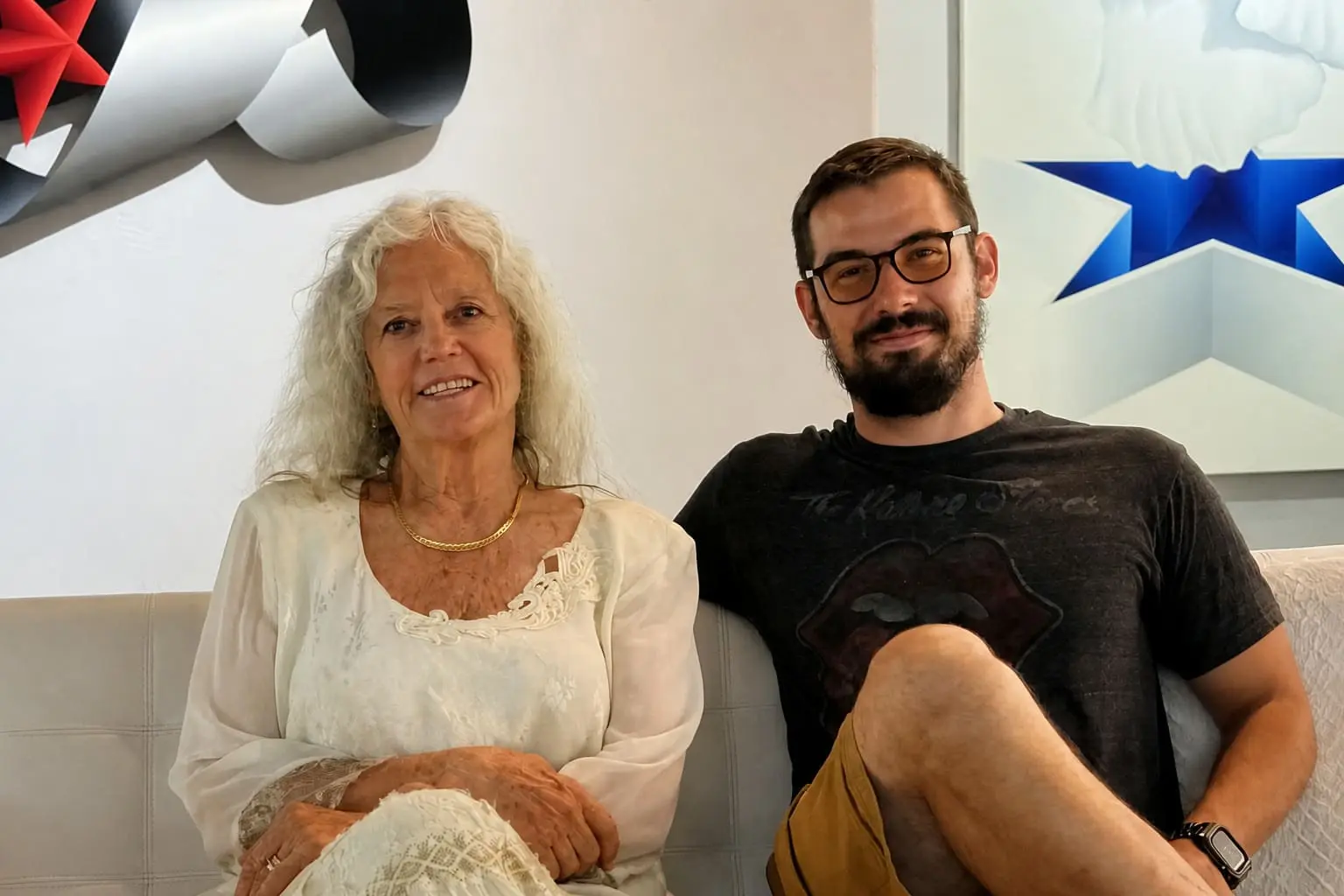
In 1977, Benini moved to the United States, arriving with paintings, thousands of books, and the work of other artists he had collected. A year later he met Lorraine Link, then a University of Florida graduate student and journalist who came to interview him. The interview became a partnership. Lorraine would become witness, archivist, advocate, and co-builder of the life around the work.
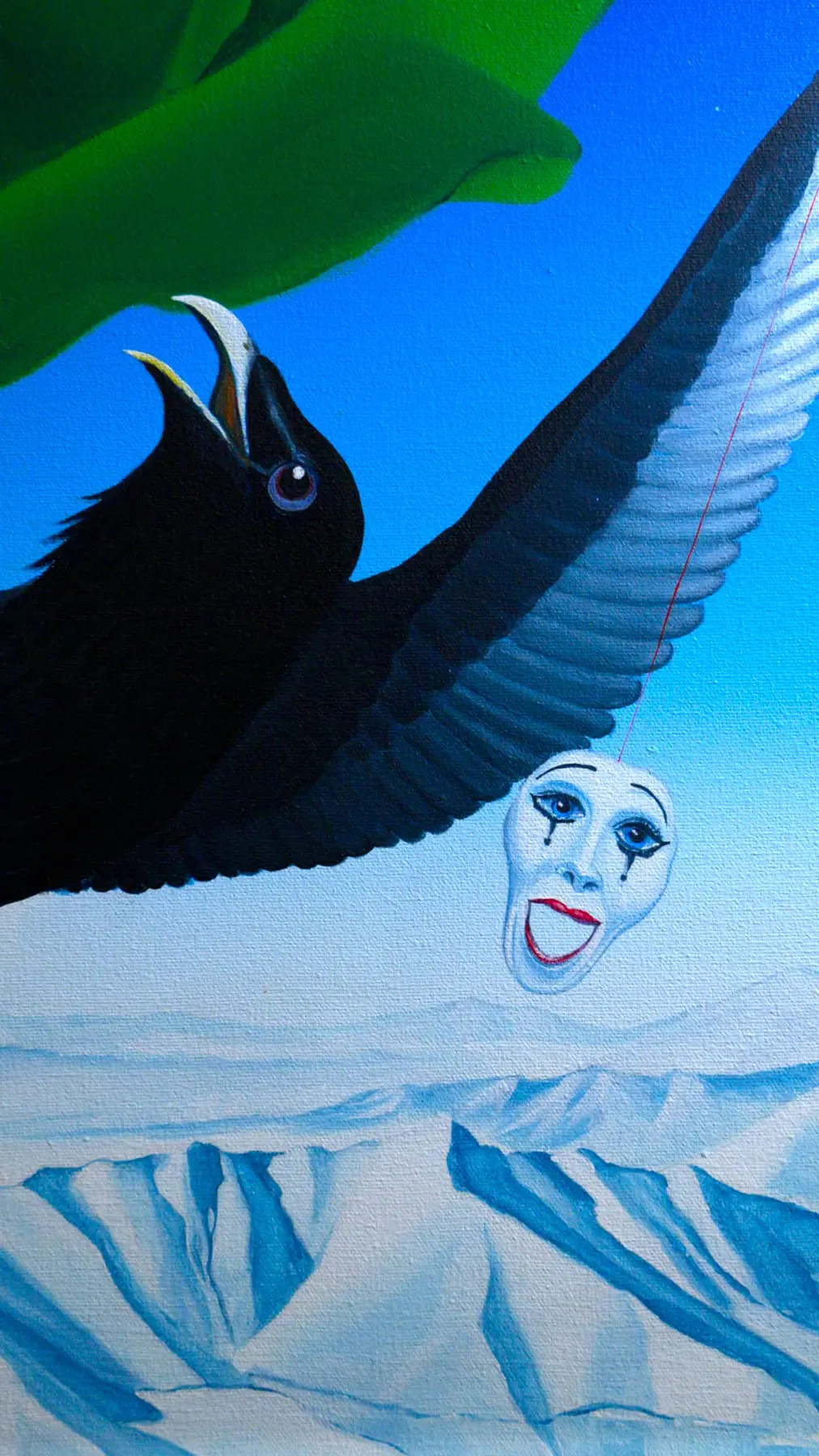
The roses changed after the move. Hard edges softened. Dream elements appeared: birds, mimes, dancers, top hats, animals, and landscapes suspended in luminous space. When Benini became an American citizen in the mid-1980s, he answered a request he had first refused and painted a white rose above the American flag. In 1987 he completed L’Ultima Rosa—the last rose—and closed a subject that had occupied him for more than twenty years.
The discipline beneath the glow
What followed was not a retreat from feeling but a change in its architecture. Squares became cubes; cubes opened into spheres, ribbons, targets, and intricate systems of geometry. The paintings can appear digitally perfect from across a room. Up close, their labor becomes visible. Lorraine explained during our interview that the acrylic works are hand-blended rather than airbrushed, often built in many layers over canvas mounted to aluminum.
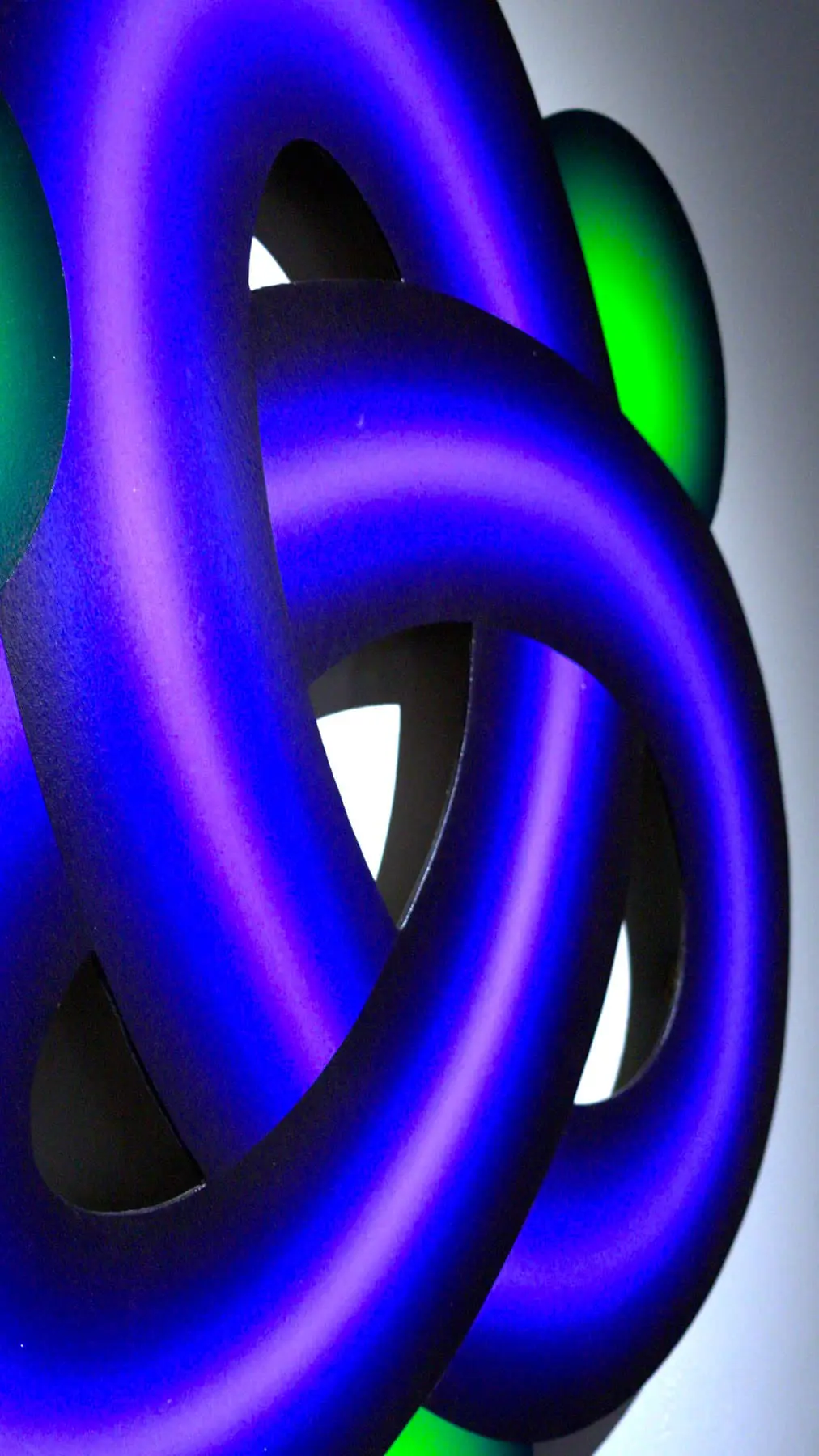
The glow is not an effect laid on top. It is accumulated. Thin passages of pigment are blended until color seems to rise from within the surface. Benini has described drawing on the theatrical richness of Baroque and Rococo art and on the pattern traditions of Islamic design, while imposing rules that keep each series distinct. The freedom in the finished image is earned through restraint.
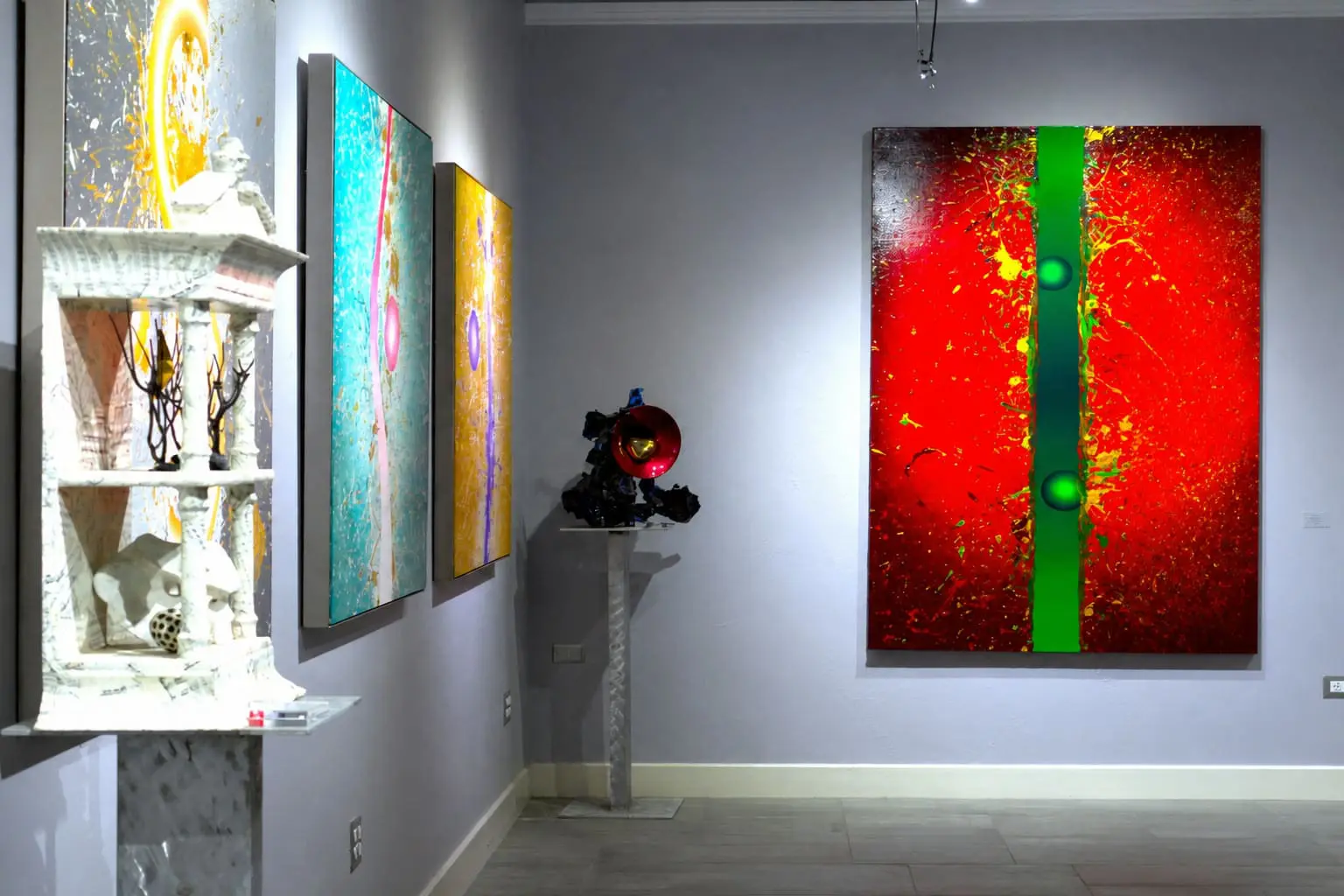
His later work keeps testing the border between painting and object. The shaped canvases curl and knot across the wall. The Target paintings make adjacent colors vibrate and sometimes seem to disappear. The seventeen-part Face of God series uses radiant centers and chaotic fields to approach creation without prescribing a religious image. Other works combine poured paint, controlled geometry, and found materials. The style changes, but the question remains: how can color make an invisible force feel present?
Lorraine, and the life built around the work
It is impossible to tell Benini’s story without Lorraine. She has helped hold the chronology of a career that now includes 163 solo exhibitions, yet she speaks less like a keeper of statistics than someone protecting the conditions that allow art to matter. In our conversation, she returned again and again to access: galleries opened wherever they lived, educational programs offered without charge, and a museum designed for people who may never have considered themselves part of the contemporary-art world.
“He never chased the money. He never chased the art headquarters. He came where he felt he could live and work best.”
Lorraine Benini
The sentence explains much of the map. Benini and Lorraine moved to Hot Springs National Park in 1988, then to the Texas Hill Country in 1999. Near Johnson City they established galleries and a sculpture ranch on 143 acres connected to a former Lyndon B. Johnson property. A hangar became exhibition space. Visitors came because the door was open.
Texas, the myth made landscape
For an Italian boy raised on black-and-white Westerns, Texas had existed first as a myth: distance, weather, horses, and a horizon large enough to stand for freedom. When Benini finally lived here, the myth became practical. The Hill Country offered space to work, night skies, solitude, and the chance to build at his own scale.
In 2014, Benini and Lorraine moved south of Marble Falls to the La Luna and Le Stelle ranch. Construction began on a purpose-built museum, and Museo Benini opened in 2015. Set on a 35-acre campus, it includes two main galleries, archives, a library, working spaces, and outdoor sculpture. The museum is one of roughly 300 single-artist museums in the world.
That designation can sound monumental, but the experience is intimate. The galleries are arranged so that time can be walked. One room may hold the precision of the 1990s beside the radiant turbulence of later abstractions; another leads backward to the shaped roses, surreal symbols, and early figurative works. The building does not flatten the career into a brand. It lets the contradictions remain.
A museum that is still becoming
Museo Benini is not a mausoleum. Benini is a living artist, and the museum remains part of an active life. That distinction gives the place its electricity. The archive is still growing. The story has not reached its final room.
Lorraine understands that permanence must be built before it is needed. In 2024, the museum’s future was placed within a nonprofit foundation so that the work, the building, and the educational mission can continue beyond its founders. The legal language of preservation may be dry, but its purpose is not. It is a promise that this singular record of one artist’s searching will remain available to the public.
“Our life has been dedicated to the fine arts and sharing the educational and cultural beauty, possibility, meditation—the potential for people to take not only pleasure, but learning experiences.”
Lorraine Benini
Watch: Inside Museo Benini with Lorraine Benini
In the film below, Lorraine walks through the museum and traces Benini’s evolution—from the roses and symbolic paintings to the ribbons, geometric works, and Face of God series.
Standing in the galleries, the easiest temptation is to search for a single image that explains Benini. The museum resists that. The rose is not the ribbon. The ribbon is not the poured field. The dream figure does not predict the target. Yet the rooms feel connected by a restless fidelity—to color, to disciplined work, and to the belief that an artist is allowed to outgrow even the thing that made him known.
Outside, the Hill Country returns: limestone, cedar, long light, and the quiet road back toward Marble Falls. Inside, color keeps moving. It has crossed countries and decades, survived departures, shed its own symbols, and found a home large enough to hold the changes.
Visit Museo Benini
- Location: South of Marble Falls in the Texas Hill Country
- Admission: Free
- Current public hours: Saturdays, 10 a.m.–6 p.m.
- Groups and weekday visits: Available by appointment
- Plan your visit: museobenini.com
- Explore Benini’s work: benini.us
Hours and access information can change. Confirm details with Museo Benini before traveling.
Continue exploring
More stories from the field
Fort Worth’s Courthouse Outlasted the Officials Who Built It
Fort Worth’s 1895 courthouse came in under budget—and still cost the county judge and commissioners their jobs. Explore the landmark’s history, restoration…
Read the story →
The Last Cut: How Swift & Company Made Fort Worth a Packinghouse City
Swift & Company helped build Fort Worth. Explore the workers, packinghouses, and surviving fragments behind the Stockyards story.
Read the story →
Inside the Atlas Missile Museum of Texas at Oplin
Go inside Oplin’s Atlas Missile Museum with Jonny Goodday and Bruce Townsley, where Cold War history and a remarkable community restoration meet.
Read the story →Reader Poll
Stay close to the road
Follow the next story.
Occasional article updates, photographs, and films from the field.
Help document the places worth remembering. Support the work →
No Responses