

Explorations
Fort Worth’s Water Gardens: The $6.5 Million Renewal Ahead
The Fort Worth Water Gardens begin by changing the sound of the city. Traffic thins beneath a rising hiss. Concrete walls close around the sky. Then the ground opens and water becomes the architecture.
In this story
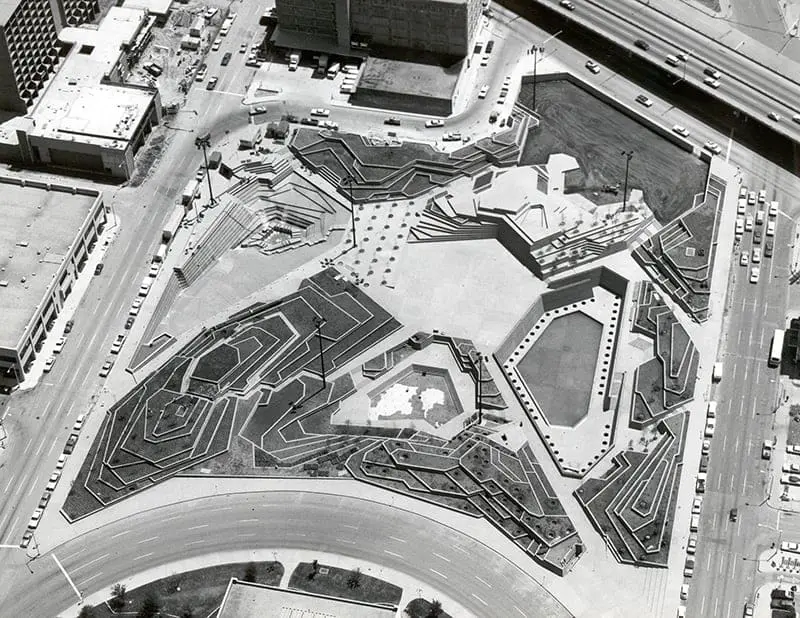
At the south edge of downtown, the Fort Worth Water Gardens occupy 5.4 acres of steps, terraces, planes, pools, and trees. The park is often described as a fountain, but that word feels too small. This is a sequence of environments built from the different personalities of water.
Fort Worth Water Gardens: a modern landscape for downtown
The Amon G. Carter Foundation gave the Water Gardens to the City of Fort Worth, and the park was dedicated in 1974. Architects Philip Johnson and John Burgee designed it during a period when cities across the country were experimenting with ambitious public spaces as tools for downtown renewal.
The site carried older history. The city identifies this ground as part of the area once known as Hell’s Half Acre, Fort Worth’s nineteenth-century district of saloons, hotels, gambling, vice, and violence. By the time the Water Gardens arrived, the visible traces of that neighborhood were gone. The new landscape did not reconstruct the past; it placed an abstract, modern civic space over land already dense with memory.
Four moods of water at the Fort Worth Water Gardens
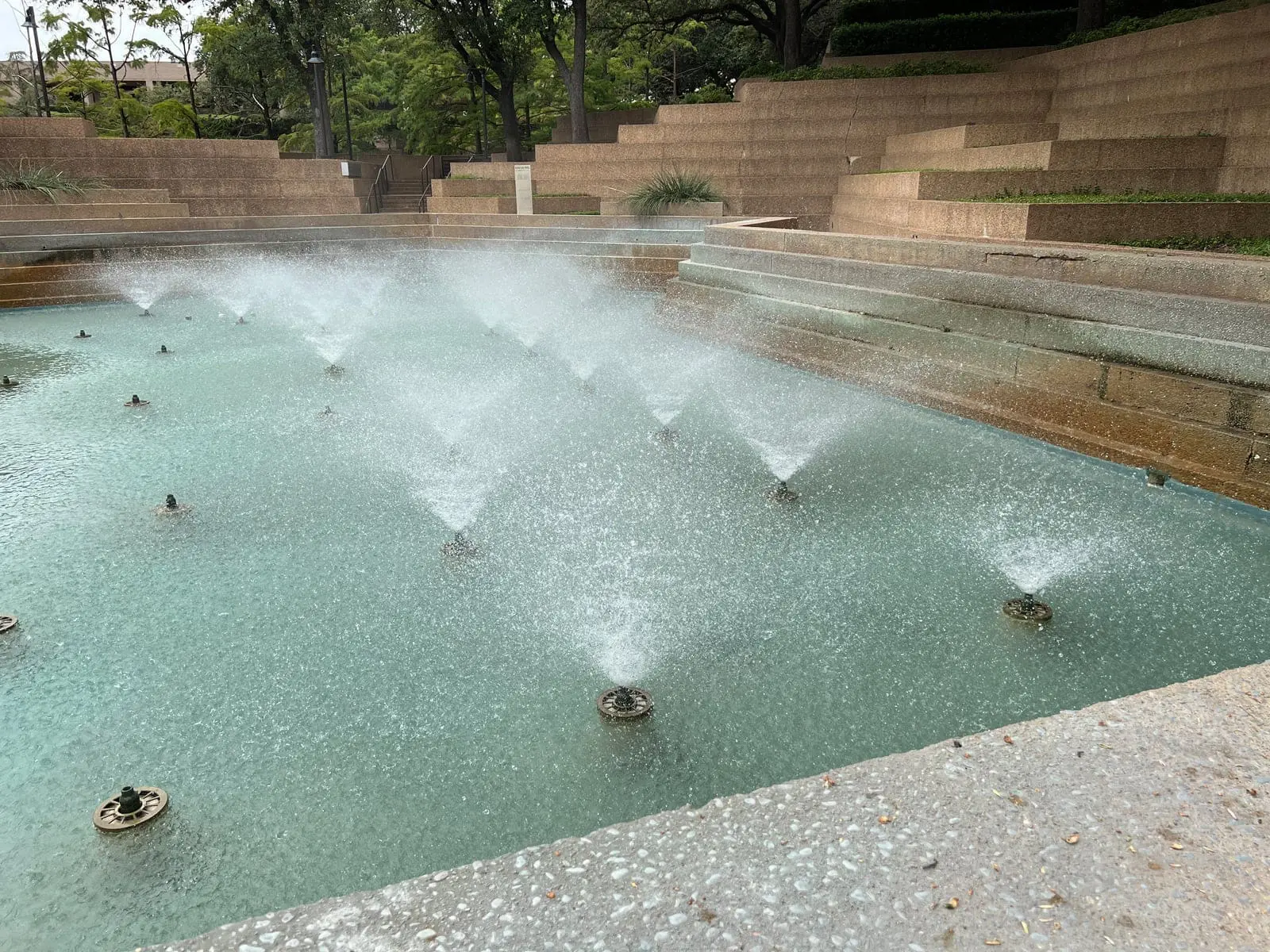
The park unfolds through contrast. The Quiet Pool draws water down walls into a sunken plane shaded by trees, creating stillness in the middle of downtown. The Aerated Pool uses forty nozzles to lift water into a field of mist and white motion. A wet wall and entrance cascades create their own transitions.
Then there is the Active Pool. Water rushes down a steep, stepped canyon toward a basin 38 feet below. Visitors descend on broad, table-topped steps while sound intensifies and the city disappears. The experience is carefully controlled but emotionally wild: architecture creates the sensation of entering the force it contains.
The City of Fort Worth reports that the park circulates about 19,000 gallons per minute, with roughly 10,500 gallons moving through the Active Pool alone. The engineering is hidden behind an experience that feels immediate and elemental.
Concrete as landscape
At the Fort Worth Water Gardens, Johnson and Burgee did not disguise concrete as nature. Walls remain walls; steps remain steps. Yet scale, repetition, changing elevation, trees, and moving water produce a landscape as psychologically varied as a canyon or garden. The central square, the twenty-foot rise called the Mountain, and the quieter lawn and stage areas make the park a small city within the city.
That theatrical quality has drawn filmmakers and musicians for decades. But the gardens are most powerful without a camera crew. A person can stand above the Active Pool, sit beside the Quiet Pool, or watch spray catch evening light and experience three completely different ideas of water within minutes.
Visiting the Fort Worth Water Gardens safely
The Water Gardens encourage close looking, but they are not a swimming area. The city prohibits wading and asks visitors to treat the pools with the caution they would bring to a natural body of water. The distinction is important: a designed environment can still contain real depth, force, and risk.
Fort Worth has changed around the park. Towers, the convention center, transit, hotels, and new development have altered the skyline and the routes by which visitors arrive. The gardens keep doing what they did in 1974: subtracting the city one sound at a time until water is all that remains.
What is changing: the 2026 renewal
Update, August 2026: Fort Worth is preparing a major renewal of the Fort Worth Water Gardens, aimed at the machinery and public-space systems that have kept the fifty-year-old landmark alive. The city lists the $6.5 million project in its final design phase, funded through the 2022 Bond Program, with completion targeted for 2027.
The work is expected to unfold in phases rather than remake the gardens all at once. Downtown Fort Worth, Inc. reports that the Active Pool is likely to come first. Plans include repairs or replacements involving pumps, pipes, storm drainage, electrical systems, pedestrian lighting, hardscape, and landscape plantings. The city also specifically identifies upgrades to the mechanical equipment serving the aging fountains.
That distinction matters. This is not a plan to erase Philip Johnson and John Burgee’s design or soften its monumental character. It is the quieter labor of preservation: renewing the hidden systems that allow water, sound, light, and concrete to perform as one work of civic architecture. Fort Worth voters also approved a separate 2026 parks bond proposition that includes future infrastructure and facility investment at destinations such as the Water Gardens, though the city’s currently listed $6.5 million improvement project is funded by the earlier 2022 bond.
Because the project is still in design, its sequence and public-access impacts may change. Visitors planning a trip should check the city’s Water Gardens and capital-project pages for current operating information.
Sources and further reading
- City of Fort Worth: Water Gardens history, features, hours, and safety
- City of Fort Worth historic context: Postwar development
- City of Fort Worth: Water Gardens Improvements capital project
- Downtown Fort Worth, Inc.: July 2026 Water Gardens improvements update
- City of Fort Worth: 2026 Bond Program and election results
Continue exploring
More stories from the field

Fort Worth’s Courthouse Outlasted the Officials Who Built It
Fort Worth’s 1895 courthouse came in under budget—and still cost the county judge and commissioners their jobs. Explore the landmark’s history, restoration…
Read the story →
The Last Cut: How Swift & Company Made Fort Worth a Packinghouse City
Swift & Company helped build Fort Worth. Explore the workers, packinghouses, and surviving fragments behind the Stockyards story.
Read the story →
Inside Fort Worth’s Stockyards Museum with Teresa Burleson
Join Jonny Goodday and museum director Teresa Burleson for the photographs, people and working history behind Fort Worth’s Stockyards Museum.
Read the story →Stay close to the road
Follow the next story.
Occasional article updates, photographs, and films from the field.
Help document the places worth remembering. Support the work →
No Responses