

Fort Worth Stories
The Plan Beneath Us: What a 1966 Fallout Shelter Handbook Still Teaches Us
A handbook from Nazareth Hospital opens a quieter story about Cold War shelters, the buildings around us, and the practical work of looking after one another.
In this story
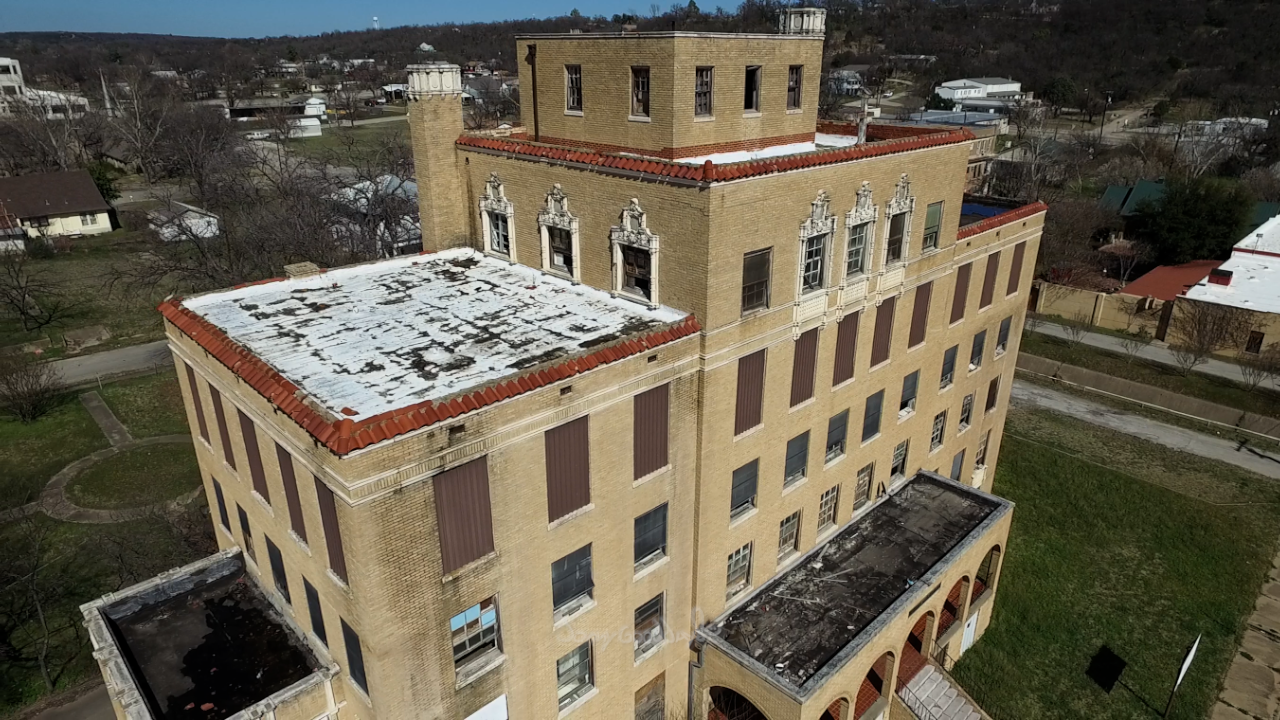
This handbook came from Nazareth Hospital in Mineral Wells. Its cover reads December 1966: Handbook for Fallout Shelter Management. The rooms I filmed there stand empty, but the book was written for a room full of people: families, strangers, someone needing medicine, someone trying to find out what happened next.
I expected a relic of the Cold War. What kept me reading were the ordinary problems beneath the extraordinary threat: water, food, sanitation, sleep, reliable information, and responsibility for the people around you. Those questions became the starting point for my film, The Plan Beneath Us.
Watch The Plan Beneath Us
Watch the full film on YouTube.
Download the handbook for free
Choose the original photographic scan or the edition arranged for easier reading and printing. Both files are free to download, with no signup required.
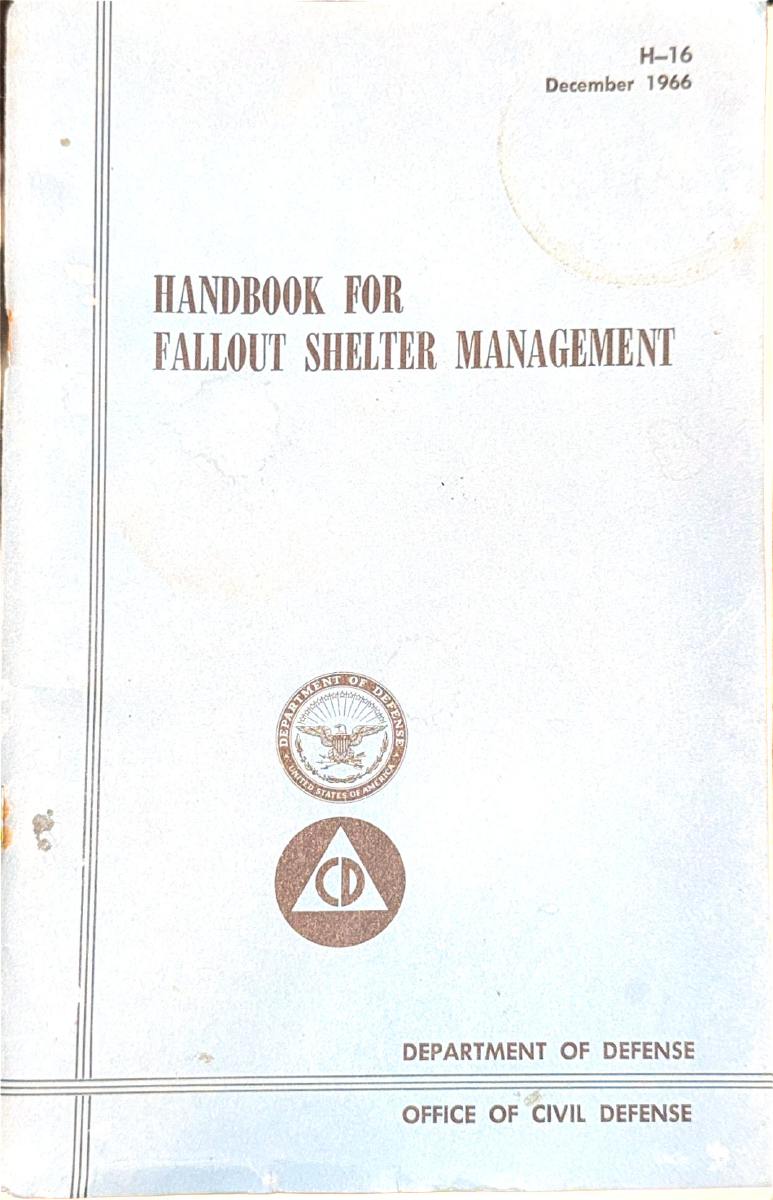
Original handbook PDF
The photographic scan preserves the book's original pages and appearance, including photographed spreads.
December 1966 · 48 scan pages · 16.2 MB
Printer-friendly edition
A text-based historical reprint with reconstructed typography, tables and diagrams, arranged for clearer reading and economical printing.
Historical 1966 content · 95 pages · 230 KB
A note before reading: Both downloads reproduce historical material. The printer-friendly edition changes the presentation, not the date or authority of the advice. It is not updated emergency guidance. Use the current official resources linked below when making a plan today.
A second map beneath the city
During the Cold War, familiar buildings acquired another purpose. A post office could handle mail while parts of the structure were identified as potential protection from fallout. The National Fallout Shelter Survey and Marking Program began in 1961, identifying shelter space in existing buildings, as the National Park Service explains in its history of civil defense.
A 1971 Fort Worth and Tarrant County shelter plan lists the Main Post Office, the Texas and Pacific freight building, and the Tarrant County Courthouse. I have filmed these places over the years, often thinking first about their architecture. The list reveals another layer of their story.
It does not establish whether any space is maintained, accessible, or designated for shelter use today. Nor does a room appearing in my footage prove it was the designated portion of a building. A historical address is a starting point for understanding the past, rather than a set of directions for an emergency now.
What still feels useful
The handbook turns survival into work someone must actually do: take an inventory, organize supplies, communicate clearly, and find out who needs assistance. Its ration tables and technical directions belong to their time. The habit of checking what is available, and who depends on it, remains useful.
For water storage today, the CDC recommends at least one gallon per person, per day, for at least three days, and suggests trying for two weeks when possible. Extra may be needed for hot weather, illness, pregnancy, and pets. For four people, that three-day starting point is 12 gallons.
A practical household plan should also account for food that can be used during a disruption, medicines, medical or mobility equipment, charging needs, written contacts, and pets or service animals. The CDC's emergency-kit guidance emphasizes individual needs. A generic shopping list is only the beginning.
Information is another supply. A compatible NOAA Weather Radio receives official weather warnings and other emergency messages. Local alerts and written contact information provide additional ways to stay connected when familiar routines are interrupted.
Where the old book must give way
Different hazards require different responses. For a radiation emergency, current CDC guidance is to get inside, stay inside, and stay tuned to officials. A basement or the middle of a building may offer protection. Follow official directions; an unsafe structure or a life-threatening condition can change what is necessary.
Flooding presents a different problem. The National Weather Service advises moving to higher ground and obeying evacuation orders. During a power outage, the CDC says portable generators belong outdoors, more than 20 feet from doors, windows, and vents, never inside a home or garage.
These distinctions matter more than the reassuring presence of an old shelter sign. Preparation begins by understanding the hazard and listening to current local instructions.
The part worth keeping
The archival shelter scenes in the film are government training dramatizations, not recordings of a nuclear emergency. My location footage records conditions when I visited, rather than an inspection of these buildings today.
What connects the old pages to the present is smaller and more human than a prediction about the next crisis. Supplies have to be checked. Responsibilities need to be understood. Someone nearby may need help receiving an alert, charging equipment, or reaching another person.
A bottle of water, a working radio, a written number, a neighbor who knows they have someone to call: preparation can begin quietly, before it becomes urgent.
Sources and film notes
Historical documents and current guidance were reviewed on October 30, 2026. The original handbook is H-16, Handbook for Fallout Shelter Management, December 1966, U.S. Department of Defense, Office of Civil Defense.
- National Park Service: Cold War civil defense and the shelter survey
- 1971 Fort Worth / Tarrant County shelter plan, page 14
- National Archives: Fallout shelter photographs and records
- Occupying a Public Shelter, U.S. Army / Office of Civil Defense training film, c. 1965–66; Prelinger Archives / Internet Archive
- CDC: Creating and storing an emergency water supply
- CDC: Emergency kits and individual access needs
- CDC: Radiation emergency safety
- NOAA Weather Radio; National Weather Service: Flood safety; CDC: Carbon monoxide and generator safety
Film and original location footage by Jonny Goodday. Historical documents and archival training material are credited above.
Continue exploring
More stories from the field

Fort Worth’s Courthouse Outlasted the Officials Who Built It
Fort Worth’s 1895 courthouse came in under budget—and still cost the county judge and commissioners their jobs. Explore the landmark’s history, restoration…
Read the story →
The Last Cut: How Swift & Company Made Fort Worth a Packinghouse City
Swift & Company helped build Fort Worth. Explore the workers, packinghouses, and surviving fragments behind the Stockyards story.
Read the story →
Inside Fort Worth’s Stockyards Museum with Teresa Burleson
Join Jonny Goodday and museum director Teresa Burleson for the photographs, people and working history behind Fort Worth’s Stockyards Museum.
Read the story →Stay close to the road
Follow the next story.
Occasional article updates, photographs, and films from the field.
Help document the places worth remembering. Support the work →
No Responses